Nat Segaloff
Nat Segaloff
  • Home
  • About
  • Books
  • Audiobooks
  • Videos
  • Blog
  • Contact
  • Home
  • About
  • Books
  • Audiobooks
  • Videos
  • Blog
  • Contact

Forgetfulness of things past

Burn, LA, Burn

12/10/2017

1 Comment

 
Picture

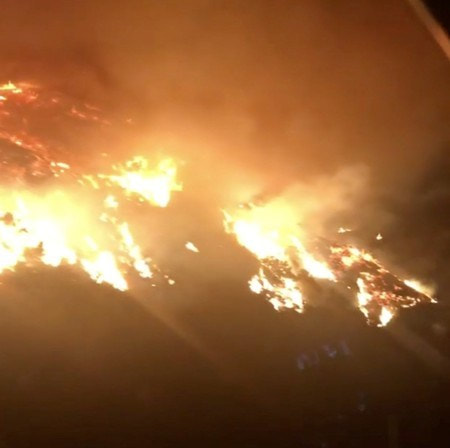
As I watch Los Angeles burn (December 5) my mind is drawn inexorably to Nathanael West’s 1939 novel, The Day of the Locust. Its protagonist, studio artist Tod Hackett, concludes that Los Angeles is made of people whose eyes are so full of hate that its only fate is to fall in a holocaust. The happenstance that West’s story was published in 1939 – Hollywood’s most acclaimed year – and articulates the the bitterness of America’s first Great Depression of 1929 seems relevant today.
 
Whatever caused the fires – lightning, power cable, arson, accident, or -- who knows -- spontaneous combustion – they have destroyed the hopes of rich and poor, citizen and non, all races and religions, Left and Right. Some will be able to rebuild, others will not. At this writing there is no indication whether Democratic Governor Jerry Brown has asked Republican President Donald Trump to declare LA a disaster area or whether, if asked, the President will accede.
There is always the chance that he will tell the city, with several layers of irony, “you’re fired.”
 
What shall become apparent as the skies clear, however, is that LA may rise again but it will not recover. The reasons have to do with the nature of urban development, and they are not yet being publicly discussed. Hints can be found in how San Francisco recovered from its disastrous 1906 earthquake and its 1988 and 1989 encores. Where, throughout the 1800s, San Francisco grew from a ganglia of tangled streets, haphazard structures, and gold-rush-flimsy housing, after it fell and burned in ’06 the city and its wealthy class were determined to rebuild for permanence and status. This meant getting rid of slums, erecting offices and tony residences, and, in short, making it too expensive for the workers who rebuilt the city to live in it. The suburban exodus began as the surrounding communities now reflect. When the 1988 and 1989 quakes did their damage, the banks, financiers, and dotcom millionaires once again rebuilt in a manner that flushed the rabble out of the better parts of the City by the Bay. The same plan emerged when Los Angeles fell to a quake in 1994. Huge areas were redlined by the banks and some blocks remained rubble for a decade. This was no different from what what urban renewal had been doing anyway all across America since the savings & loan bubble of the 1980s, it’s just that the natural disasters allowed developers to leapfrog over such obstacles as planning boards, licensing commissions, and social service watchdogs.
 
It’s easy to see how a similar wave can now realign Los Angeles. Although the governing and mercantile parts of the city – Old Los Angeles, it’s called – is untouched by flames, pretty much every surrounding community has been devastated. From the ultra-rich gated enclave of Bel Air to the tract homes in the Simi Valley, from the hills lining the essential 405 freeway to the mountains of Ojai and tens of thousands of acres connecting them, Southern California is poised to shift character. Rents were already too high for average people to afford. The immense costs of rebuilding will make them even more so, and with the tax base shrunk by properties that no longer exist, city services will likewise suffer. The over-arching question is whether the insurance companies can withstand the hit of multi-billion dollar payouts. On the positive side, there will be a building boom that will put contractors and their crews in the driver’s seat. There might even be a need to welcome an immigrant labor force. Talk about irony.
 
Dorothy Parker once wrote that Los Angeles is seventy-two suburbs in search of a city. What she meant was that LA grew up neighborhood by neighborhood with only the slightest effort to yield to a governing body (the City Council). You can bet that the Los Angeles City Council will soon be besieged by residents, businesses, builders, and industries looking for deals to rebuild with tax benefits instead of relocating. It’s the beginning of a free-for-all that will reshape the city.
 
In Day of the Locust, Tod Hackett, in his spare time, painted a mural that showed the city in flames. Now that images of the LA fires have been spread across the internet in all their hypnotic reality, Nathanael West’s theme is even more powerful. Will Los Angeles become a city of hate or will its eyes be opened to the needs of all its residents? Will it make a fresh start or become myopic? I don’t have the answer, but, given that Los Angeles is a mixture of desperation, fantasy, greed, and hope, I’m expecting the fires to continue burning, not on the land, but in the people who live on it.


1 Comment
Stephen Patten
12/11/2017 12:01:42 pm

Gee, Nat, I had all but forgotten Nathanael West. Whether he was prescient or just a good prognosticator...? I barely remember Day of the Locust, as my psyche was so disturbed by Miss Lonelyhearts, which I read as a teenager. I remember writing in a school essay that reading it made we wonder if I should bother growing up.
Your LA observations certainly mesh with West's Apocalypse Soon .vision. It seems to me to follow as the day the night that there are always people ready to make money from disaster.

Reply


Leave a Reply.

    Categories

    All

    RSS Feed

Copyright © 2026 Nat Segaloff